The hunger crisis in Toronto has deepened—but so has our resolve to meet this moment with action, advocacy, and compassion.
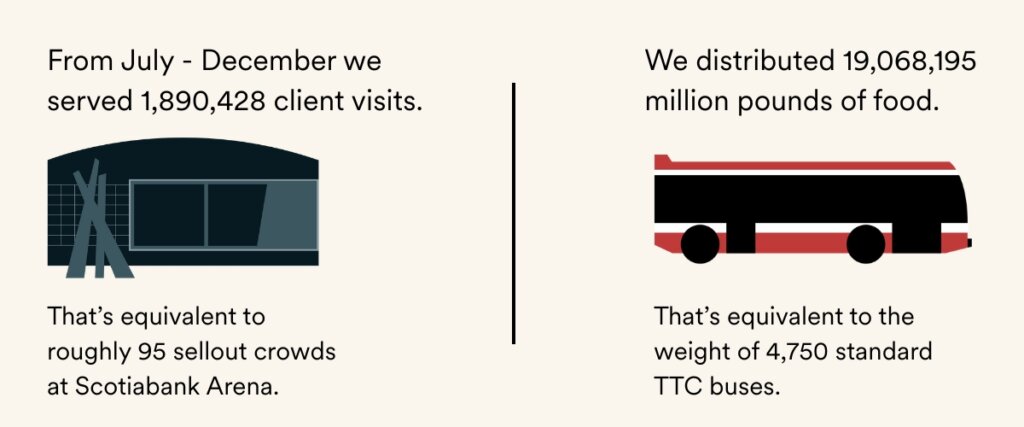
Thanks to your unwavering support, we served 1,890,428 client visits between July – December 2025 (up from 624,343 during the same period in 2020), and distributed 19,068,195 lbs of food through our network of food banks (compared to 6,819,682 in 2020).
We expanded our reach across the city and launched seven new food programs with existing members. From Rexdale to Scarborough, these programs bring dignified food access directly to the communities that need it most—seniors in supportive housing, families in underserved neighbourhoods, and 2SLGBTQAI+ youth seeking safer spaces.
At the same time, we’ve been pushing harder than ever for systemic change. Our Who’s Hungry 2025 report revealed a stark reality: food bank visits reached an all-time high of 4.1 million—a 340% increase since 2019. What was once an emergency has become a long-term crisis. That’s why we’ve doubled down on advocacy, championing the Canada Disability Benefit, celebrating policy wins in the Federal Budget, and building relationships with elected officials to drive real change.
This work is only possible because of you. Together, we’re not just feeding our neighbours—we’re fighting for a future where no one in our city goes hungry.
We supported the start of seven new food programs, further expanding our reach across the city and improving food access for communities.
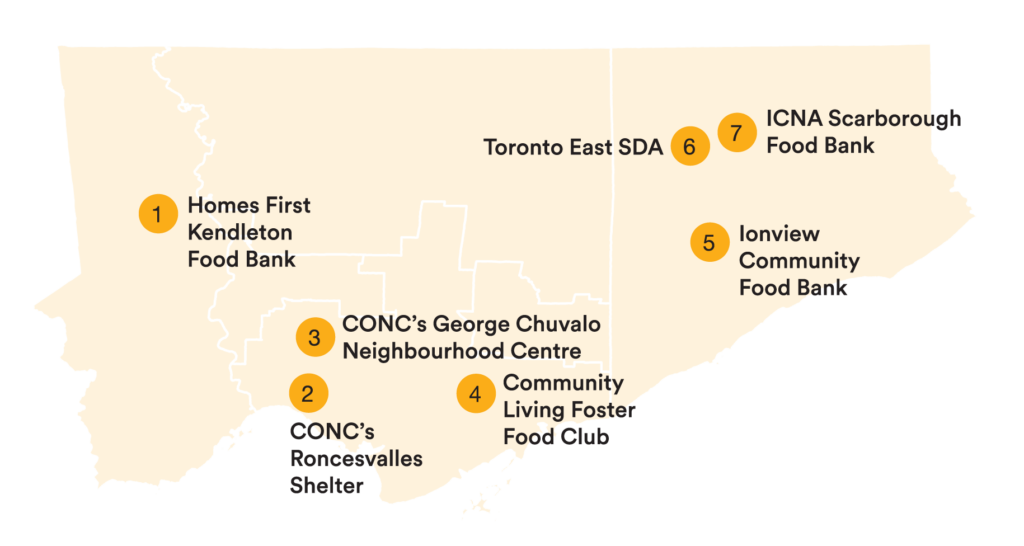
Tucked away in the tight-knit community of Kendleton in Rexdale, the Homes First Kendleton Food Bankopened its doors in July. The food bank brings dignified food access directly to residents of 101 and 121 Kendleton Ave.—supportive housing buildings where over 60% of tenants are seniors. The partnership expanded when Homes First reached out to Daily Bread about opening a food bank for three buildings they operate: one seniors-only apartment and two assisted living buildings supporting people who were recently unhoused or living with mental health or other health challenges. Using network health and resiliency data, our Member Services team discovered residents were not accessing nearby food banks. Given the community’s unique circumstances, Daily Bread determined that a closed program—exclusively for these buildings—would be most effective and respectful. Run by a dedicated team of Homes First staff, peer workers, and community volunteers, the food bank complements existing services and resources within the buildings.
This November, ICNA Relief Canada opened the doors to the ICNA Scarborough Food Bank in the Al-Fauz community near Sheppard and McCowan. What started as a small program offering Halal food items monthly has now grown into a weekly service. Dr. Kashif and his dedicated team saw a clear need in their community: access to fresh groceries that reflect the cultural and dietary needs of their neighbours. Operating out of a local mosque, the food bank primarily serves Muslim clients but welcomes anyone who needs support. Using an in-person, choice-based model, clients can book appointments and select the groceries that work best for their families.
Toronto East SDA added a Saturday morning breakfast program to their food bank operations in October, increasing food resources to the vulnerable Agincourt-Malvern community. The program serves about 750 meals a month.
A multi-service agency that provides its clients with housing, food, and support accessing essential services, Christie Ossington Neighbourhood Centre (CONC) opened two new programs: a meal program and a snack program. Meals are now offered at their Roncesvalles shelter, and Daily Bread provides snacks at the George Chuvalo Neighbourhood Centre as part of after-school programming in a safer space for 2SLGBTQAI+ youth.
Long-time member Community Livingturned their small tenant program into a fully functional food bank. Through the Foster Food Club, they ensure their 100 residents with developmental disabilities have the food they need to thrive. They previously ran a small food pantry mostly serving non-perishable items but saw that residents needed fresh, nutritious foods, so they transitioned to a full food bank, adding produce, eggs, meat and milk to the mix.
In partnership with The Neighbourhood Group (TNG), Frontline Connections opened an additional program in south Scarborough in December at Birchmount and Eglinton – the Ionview Community Food Bank. The new food bank will complement after-school programming, an apiary, and a community garden that are also part of Frontline’s programming for the Ionview community, and will provide more food access to the community, especially for seniors and residents of community housing buildings.
In November, the Bloor West Food Bank re-opened and is now serving clients by appointment at their new storefront location at 379 Jane St. Their team worked tirelessly to renovate and prepare the new space, offering a shopping model experience allowing clients to access food in a dignified way.

Leisa did everything right – yet illness pushed her into poverty. As a teenager, Leisa was determined to build the life she dreamed of. After being diagnosed with Sickle Cell Anemia Disease, her doctor told her that if there was anything she wanted to accomplish, she should do it now—before her illness made it too difficult. So, she did.
Still in her teens, Leisa began carving out a successful career in Canadian fashion. She supported emerging designers, held stage shows with industry leaders, and eventually built a thriving career in styling and photography. “I worked three jobs. I was always able to take care of things,” she says. But as her doctor predicted, her illness progressed. The pain and fatigue became impossible to ignore. Eventually, she had to stop working.
Today, the income Leisa receives from the Ontario Disability Support Program falls far short of what she needs to cover rent, groceries, and the costs of supporting her daughter through college.
“When my daughter started college, we basically couldn’t afford anything to eat,” she says. “My husband had just passed away, and my sister said, ‘You have sickle cell—you can’t starve yourself.’ That’s when I started going to the food bank.”
Like so many people who visit Daily Bread, Leisa never imagined she would need this kind of help. The stigma has been one of the hardest parts. “I did everything right. I went to school; I built a career. And now I feel like I failed because I have to depend on a food bank to feed me,” she says. “Somewhere along the line, something went wrong.”
Living in poverty has also reshaped her social world. She can no longer afford dinners out or even a simple drink with friends. Invitations quietly stopped, and she often feels isolated—left behind by a life she once moved through with confidence and connection.
Rising food prices have made the situation even more dire. Meat and fish—foods she relies on to manage her illness—are now out of reach. Even staples like chicken have become too expensive. She shops carefully, stretching every dollar and combining groceries with what she receives from the food bank.
Yet even as her illness has taken so much from her, Leisa hasn’t lost hope. She is writing an autobiography about her journey—one she hopes will bring understanding to the many invisible struggles people face.
For Leisa, and for thousands across Toronto, the cost-of-living crisis is not abstract. “This is a world-class city,” she says. “We all deserve to eat.”
As the hunger crisis continues, Daily Bread has been pushing for bold government action to tackle poverty at its roots and drive systemic change.
Our Who’s Hungry 2025 report—an annual profile of poverty and food insecurity in Toronto—revealed alarming trends. The hunger crisis is deepening. Food bank visits reached an all-time high of 4.1 million, over half a million higher than the previous year and a 340% increase since 2019.
What was once a short-term emergency has become a long-term reality, as more people rely on food banks more frequently and for longer periods. These are our neighbours, coworkers, and classmates—many people with post-secondary education, working multiple jobs, yet still struggling to put food on the table.
The report offers critical data and insights that guide our conversations with different levels of government and helps mobilize support and action across the non-profit sector and the broader public.
Recognizing that people with disabilities experience poverty at twice the national rate, and one-third of food bank clients identify as having a disability, Daily Bread has been a strong advocate for a fully funded Canada Disability Benefit (CDB) for years. Although CDB payments began in July, the current maximum of $200 per month remains far below what is needed to lift people with disabilities out of poverty.
To highlight this gap, we launched a campaign that began with influencers attempting the “CDB Diet,” living on just $6.67 a day for food—later revealed as the daily reality for many Canadians with disabilities. This was followed by a targeted advocacy push urging the Federal Government to raise the benefit ahead of the budget.
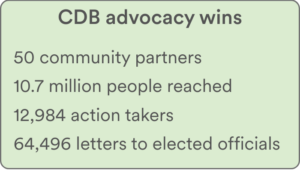
With support from more than 50 community partners, the campaign sparked a national conversation, reaching 10.7million people and mobilizing 12,984 action takers to send 64,496 letters to elected officials.
We were encouraged to see several measures we have long championed included in the Federal Budget. While the government did not increase the CDB, it introduced a one-time $150 payment to help cover the costs of applying for the Disability Tax Credit (DTC), a requirement to access the benefit.
The government also confirmed that the CDB will not be counted as taxable income and committed to reviewing and improving the DTC application process. These steps will reduce barriers and protect CDB recipients from losing other essential supports.
Other policy wins include scaling up affordable housing through Build Canada Homes, making the National School Food Program permanent, and expanding automatic tax filing to support more lower-income Canadians.
Building meaningful relationships with elected officials and government staff is central to our advocacy efforts. We do this by sharing research, hosting meetings, participating in consultations, and inviting officials to food sorts and facility tours. These engagements open the door to important conversations about long-term solutions to poverty and hunger, while helping us identify champions for our mission to end hunger in our city.
Since July, we have met with more than 40 elected officials and government staff. Highlights include a Daily Bread tour with the Honourable Patty Hajdu, Minister of Jobs and Families; meetings with Department of Finance staff to discuss strengthening the new federal CDB and the Office of the Secretary of State (Children and Youth), the Honourable Anna Gainey, on making the National School Food Program permanent, and visits from the Premier of Ontario Doug Ford, the Minister of Children, Community & Social Services Michael Parsa, and the Mayor Olivia Chow during our Thanksgiving food sort
Following the release of our Who’s Hungry report, we met with 22 elected officials across all levels of government and continue to engage them to drive action on our findings. The report also sparked debate in the legislature. Between September and October 2025, Daily Bread was mentioned 15 times in the House of Commons and six times in the Ontario Legislature—clear evidence that our research and rising food insecurity is gaining attention.
In November, Daily Bread hosted our annual Best in Class Awards, a special evening that celebrated the donors, volunteers, and supporters who share our vision of ending hunger in our city. We extend our heartfelt congratulations to this year’s award recipients:
Lifetime Achievement: Victor Willis
Exceptional Volunteer: Augustina Michael
Community Leader: Downtown Softball League
Food Industry Trailblazer: O’Dough’s Bakery
Harvest Hero: Bondi Produce & Specialty Foods
Workplace Champion: Acrisure Re Canada Ltd
Corporate Leader: RBC Foundation
Champion of Change: The Arrell Family Foundation
Outstanding Philanthropist: Donald Bainbridge Family Foundation
Operational Impact: Reid’s Dairy
Commitment to Equity: Holy Wisdom Food Bank
Profound Community Impact: SOSO World Ministries
Outstanding Food Program: Christie Ossington Neighbourhood Centre