At Daily Bread Food Bank, we are in the unique position of actively trying to put ourselves out of business.
While we feed the need now, we also work tirelessly to advocate for the research-backed policies that will reduce food bank demand: sufficient income supports, affordable housing, and decent work.
Our CEO, Neil Hetherington, traveled to Parliament Hill four times in three weeks this fall to tell government officials what we’re seeing on the ground and push for reform. Here’s a recap of those trips.
Neil and two members of our Research & Advocacy team, VP Sahar Raza and Chloe Bray, Policy & Government Relations Advisor, spent a whirlwind two days in eight meetings with federal officials to discuss our major federal policy pushes: a Canada Renters Credit for low-income renters to improve housing affordability; further reform on the Disability Tax Credit to make it more accessible; and a Federal Food Donation Tax Credit to encourage food producers to donate to community food programs, including school food programs.




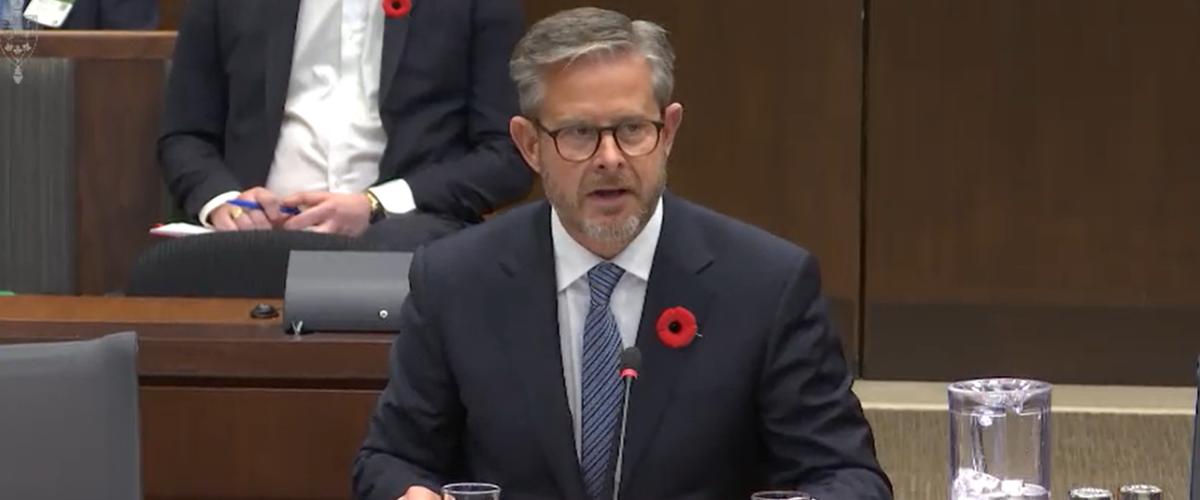
Neil spoke before the House of Commons’ Standing Committee on Agriculture and Agri-Food at an October 22 meeting to discuss Bill C-226, testifying that better food price transparency is one useful tool, but not the solution to food affordability.
After paying for housing, Toronto’s median food bank client has just $8.33 left per day for food, transit, and everything else. “A clear shelf label might show that the large bag of rice is the better deal per 100 grams. But with $8.33 a day, [food bank clients] cannot afford the large bag,” Neil said. “Information helps people who have choices. Our clients have run out of choices.”
On October 29, Neil went back to Ottawa to speak before the House of Commons’ HUMA Standing Committee about the importance of the National School Food Program and recommendations to strengthen it.
School food programs are critical at a time when one in eight children in Toronto rely on food banks. Morning meals now reach every student in every Toronto public school, about 325,000 students, saving families about $900 a year. But a city cannot carry this on the property tax base alone. We’re calling upon every order of government to pay its fair share, and its share must keep pace with food prices.
Watch a clip from his testimony
On November 5, the federal government released Budget 2026, with an emphasis on strengthening Canada’s economy, attracting investment and improving affordability. Neil was in the lock-up with reporters and stakeholders to read through the full plan before the embargo lifted.
Budget 2026 takes some steps forward to help the hundreds of thousands of Torontonians turning to food banks, but what’s missing is relief for low-income renters now. That’s why we’re calling for a Canada Renters Credit, a tax rebate that would provide direct support to low-income renters. A full credit for two million households would cost $4.72 billion — roughly the same as this year’s gas tax holiday or the one-time top-up to the Canada Groceries and Essentials Benefit — but is better targeted to those in greatest need and will have a much greater impact on reducing food bank lines.